
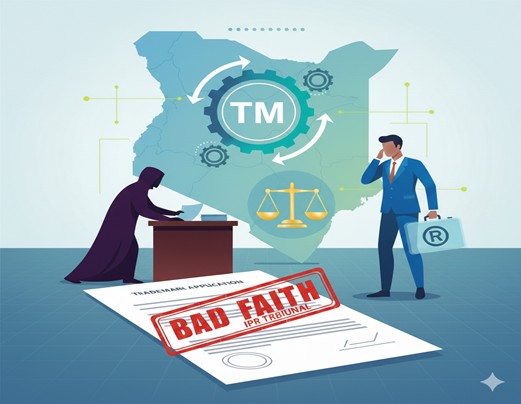
First-to-file system
In Kenya, the TM registration system follows the
first-to-file system. Meaning, a person who duly files a TM application form,
Form Tm 2, complies with the statutory requirements, and whose application goes
through the due process of examination, and publication, obtains registration
of the mark. Upon registration, the proprietor acquires the monopoly to use the
TM in relation to the goods and services within Kenya.
Functions of a trademark
The functions of a trademark are many; however, to
name a few: Trademarks serve the function of assuring the consumer of the
quality of the item, Trademarks serve to
communicate the origin/ source of the product. Trademarks also serve to attract investors to a company. Trademarks
also serve to advertise. Primarily, trademarks serve the function of
communication. I. e. communicates the origin, communicates the quality,
communicates to the investors, etc.
Facets of Bad Faith
Bad faith manifests itself in 2 forms:
1.
As an abuse of the TM registration system by a
non-user of a TM
Abuse of the TM registration system may be manifested
when a TM proprietor has no intention to
use/does not use the TM for any goods or services in respect of which the
mark was registered. Intention to use is
measured for up to 1 month before registration, while actual use of the
trademark is measured for up to 5 years post-registration.
The implication for the timelines is that an action may not be brought against a non-user of a TM unless 5 years have lapsed since the registration of the mark. Therefore, these provisions in the Trademark Act, Cap 506, Laws of Kenya, create a limitation on actions for a non-user filer.
2.
Filing while
there is another group of
proprietors /proprietors (usually the victims)
Usually, the competitor registers a mark belonging to
another group of proprietors (usually the victims). While this is a facet of
bad faith, it is very hard to deregister a prior proprietor on this point
alone. This is because most scenarios involve a competitor registering a mark
in a territory where TM is not protected.
Take, for instance, the MIKOANI TRADERS V BAKHRESA GROUP case.
The two parties are competitor companies registered in Tanzania. The victim
company (Mikoani Traders) owned the ‘Azania’ mark in Tanzania. The competitor
company (Bakhresa) registered the ‘Azania’ mark in Rwanda. When Mikoani Traders
entered the Rwanda market and attempted to register the mark, the application
was refused on the grounds of an existing mark in the registry. Aggrieved,
Mikoani Traders instituted a suit against Bakhresa Group. However, deciding in
favour of the competitor (Bakhresa Group), the court ruled that TM are
territorial rights and that at the time the Bakhresa Group moved to register
the ‘Azania’ mark in Rwanda, the mark had no owner in Rwanda.
CONCLUSION
When attacking a proprietor of a mark for revocation
on grounds of bad faith filing, a person has to have in mind the functions of a
trademark; this is important in showing the court that the TM was not used for
any of the functions during the 5-year window. This ground may be achieved by
conducting market surveys and sweeps.